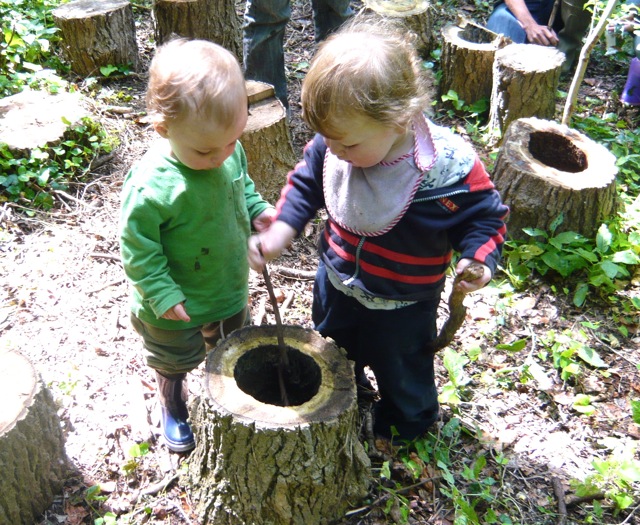
 What is ‘Forest School’?
‘Forest School’ is an ethos, an approach to learning where everyone can succeed.
It is a way of facilitating and nurturing children’s learning through the provision of hands-on experiences in an inspirational, outside and natural environment.
It has it’s roots in Scandanavia where outdoor nurseries are numerous and the benefits to children’s development have been well documented.
Over a period of time paticipants are given increasingly challenging but achievable tasks outside that extend their skills and knowledge and develop their independence and confidence.
The process of progressive achievement engenders self belief whilst the freedom to explore ignites the innate desire to learn which is present in all of us.
Although forest school was initially aimed at younger children, our group works long term with teenagers who participate regularly in purposeful forestry and conservation projects. We have been supported providers of the nationally recognized John Muir Award since 2008. We are very pleased that some young people are going onto courses in countryside management and forestry as a result of their experiences with us.
Key features of any ‘Forest School’
The use of woodland, other wild spaces and/or school grounds
- A high ratio of adults to pupils in small groups making detailed observation and assessments of each child’s progress guided by trained Forest School Leaders.
- A flexible child led approach to learning which accommodates a range of learning styles which can be adapted for different ages and all abilities.
- The freedom to explore using multiple senses (vital for encouraging creative, diverse and imaginative play).
- Learning which links to the national curriculum in innovative ways that encourage children to develop their curiosity and motivation to learn.
Benefits of ‘Forest School’
- Children love to be outside. Learning is child led and memorable. They discover things for themselves and remember it forever! Motivation to learn is increased
- A wider range of knowledge/expertise is developed than in the classroom
- Elements of the curriculum can be presented in a practical context allowing kinaesthetic learners in particular to shine
- The higher level of freedom allows children to develop independence; the confidence to assess, take and manage risk and the ability to initiate their own play and learning
- Children are more accepting of ‘rules’ because they can help devise them. They are keen to keep attending and don’t want to jeopardise their place on the sessions. They also understand that the consequences of ignoring rules could be real danger.
- It is an ideal opportunity to influence children to be caring custodians of the environment. As they connect with the natural world at the Forest School site, many of them grow protective of it. Education for sustainability is promoted more easily in this context than in a classroom
- The inspiration of being in a ‘wilder’ place allows creativity and imaginative play to flourish.
- Children develop a range of practical, personal and social skills that equip them for life. They learn to work co-operatively and their values change
- Nobody can fail. EBD children and those with a range of complex difficulties can benefit. Children often talk over their worries in this environment and develop skills to manage their emotions better.
- Children improve their balance, co-ordination and general fitness through physical activity
- They want their parents to take them into the outdoors more often and use the knowledge they have acquired to enhance the experience
- Forest School is an opportunity for male family members to become involved. It helps develop school community and strengthen links with the wilder community
- Forest School provides opportunities to link with other initiatives such as Eco Schools, SEAL (PHSE), Every child Matters, and the Manifesto for Learning Outside the Classroom.
What do we do at sessions run by our group?
Every Forest School Leader will use the same ethos but adopt a style of delivery appropriate to the site, group composition and the staff available.
We complete detailed plans for every session but are always flexible. We often step aside and adapt to an alternative agenda worked out by the children!
However most sessions involve some of the following:
- Nature games – attuning children to the natural world through fun games
- Arts and crafts – making useful and beautiful things from natural materials
- Nature detectives – activities based around species and habitat
- Wonder walks & Earth Education – focusing on the wonder of nature felt through the senses
- Storytelling – listening to traditional tales and creating our own stories
- Musical instruments – making & playing them, singing & improvisation
- Bush craft – practical skills in fire lighting, den building and camp cooking
- Orienteering – reading maps, making your own maps and following trails
- Weather stations – investigate how the weather works, explore seasons
- Living History – use your woodland as a venue for experimenting with ancient crafts; cookery, dyeing, pottery, basket making and also for imaginative re-enactment in costume
- Team building
- Conservation activities; every session has a conservation objective and children also get the chance to participate in a bigger project if they wish
- Circle time; opportunities to reflect and discuss with the group, learning to listen to and value other perspectives